


Municipal road lighting QA/QC means checking housing protection, production photometry and control compatibility before shipment. This Square II guide brings together multi-point coating inspections, production-sample photometric checks and configuration-specific interface review.
For municipal street lighting projects and large-scale government procurements, verifying product quality goes beyond reviewing lab certificates. Municipal engineers and EPC contractors need certainty that bulk-manufactured luminaires will match pre-bid photometric simulations and endure harsh environmental conditions for years.
In major infrastructure deployments—such as the 105,000-unit smart street lighting project in Jordan—LUXIFIC implements rigorous Quality Assurance and Quality Control (QA/QC) protocols for the Square II series. Here is how we validate optical performance, environmental resilience, and smart control integration before shipment.
1. Environmental Resilience: Beyond Standard Testing
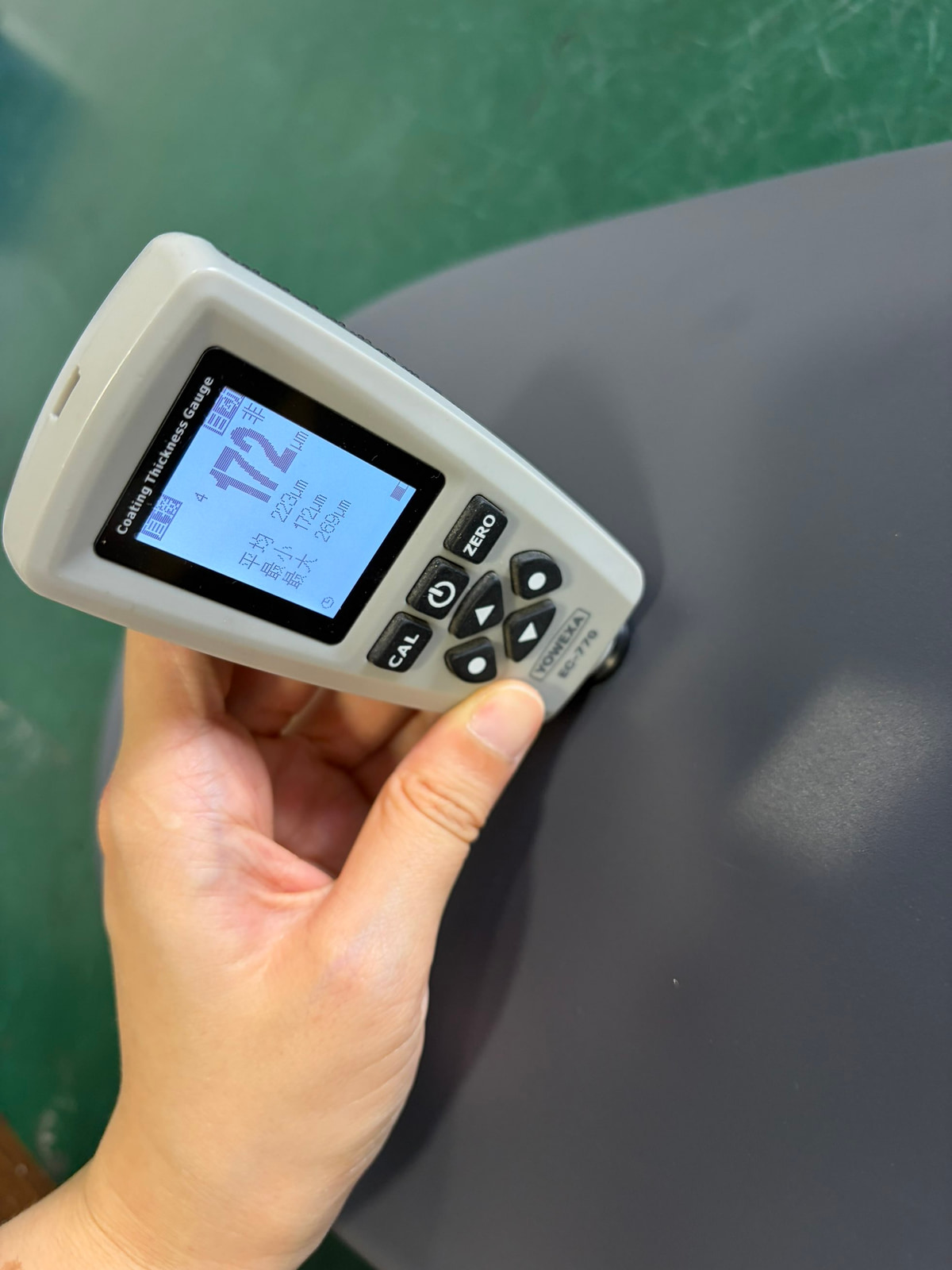
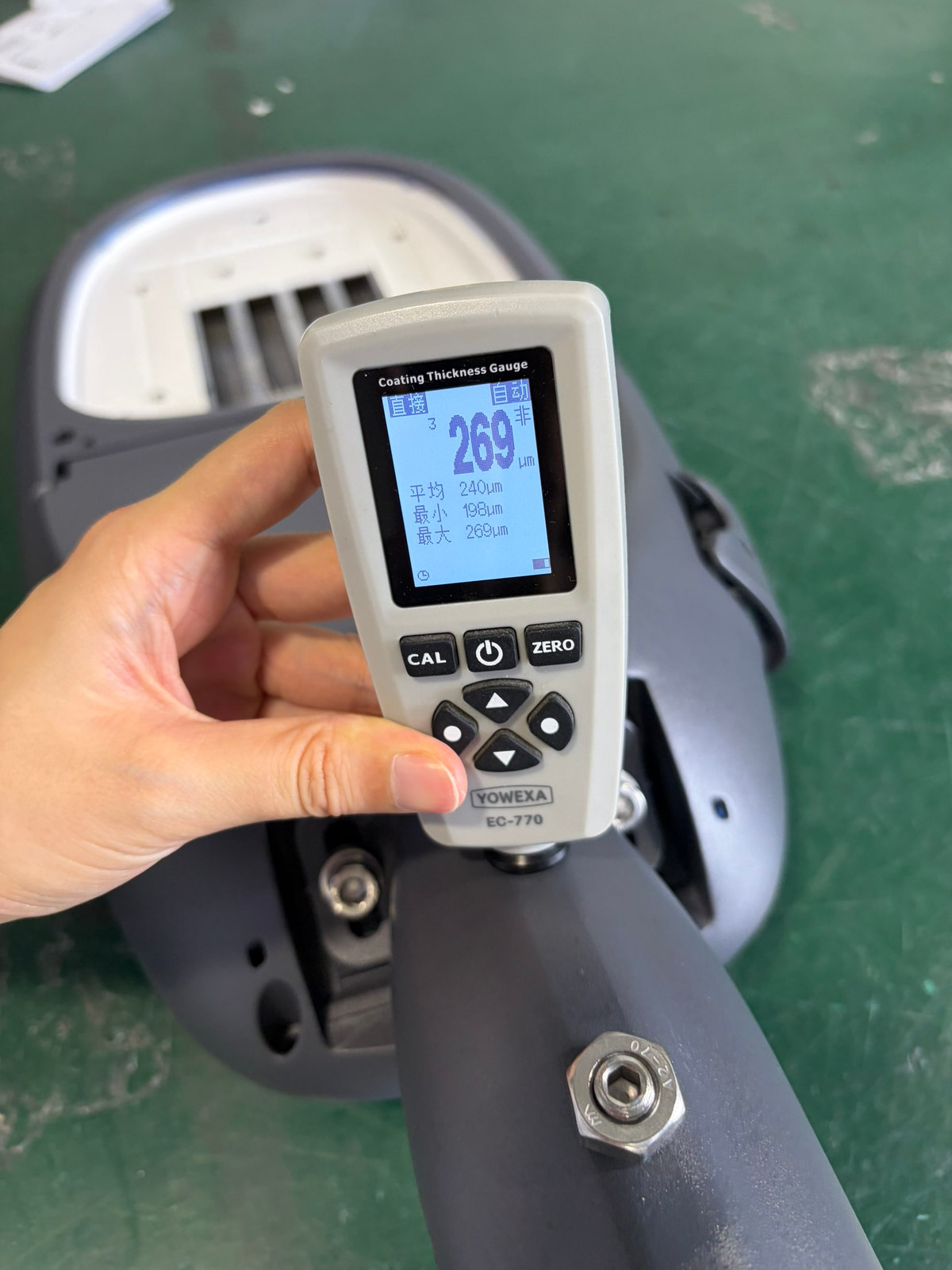
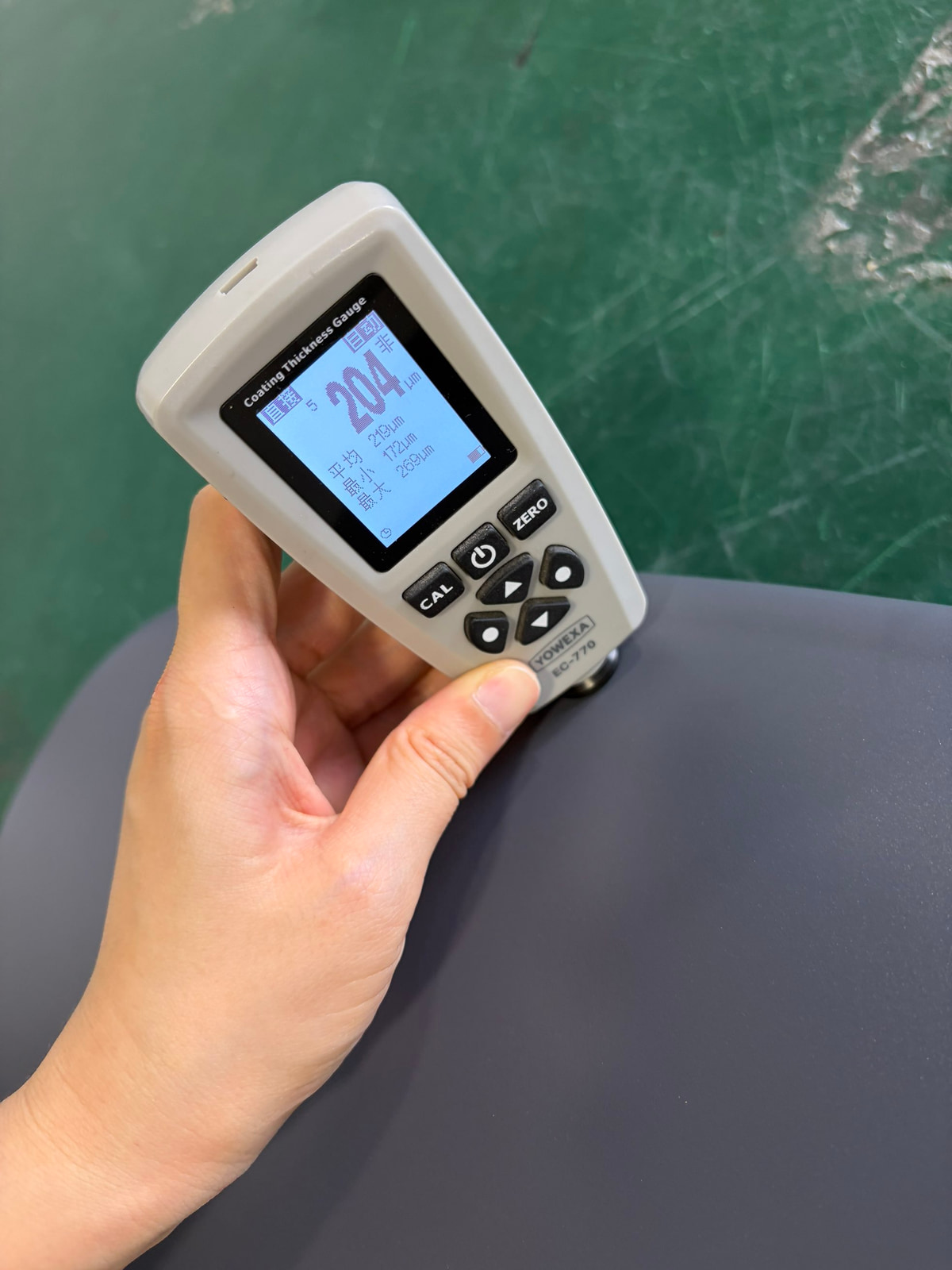
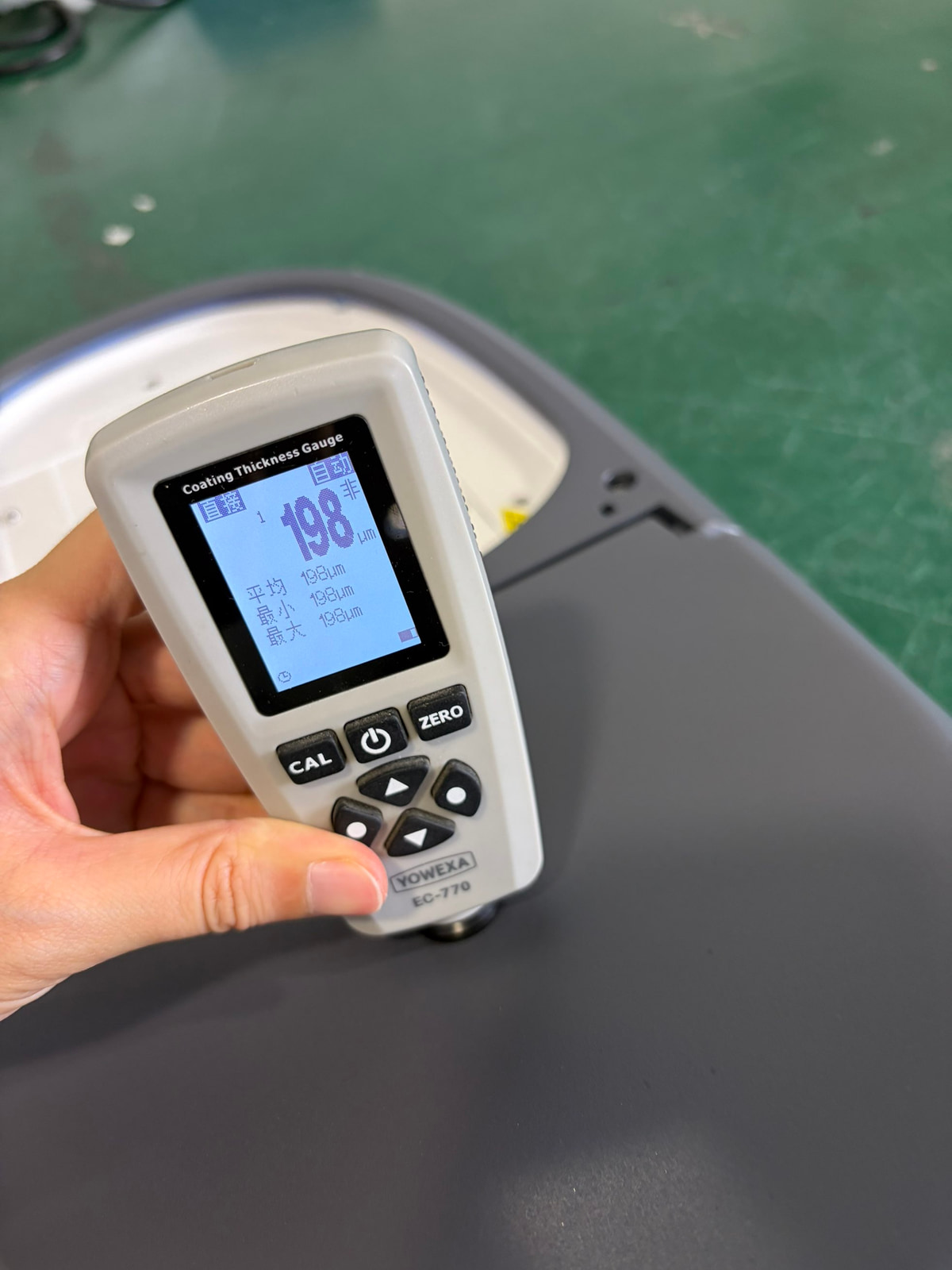
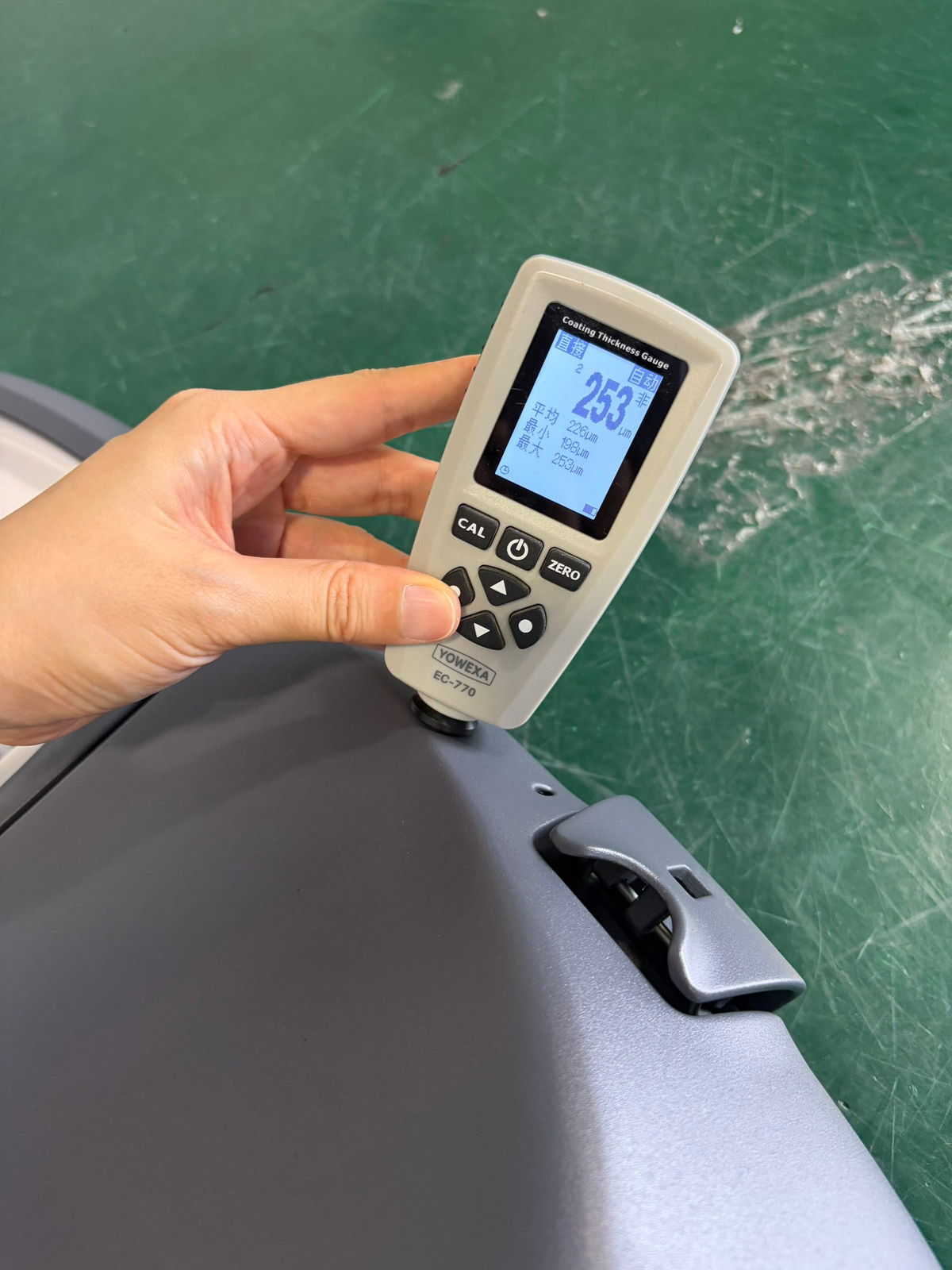
Coating-thickness inspection is a multi-point check of the luminaire housing. Record individual readings and review the applicable enclosure-protection reports before approving the selected configuration.
Lighting infrastructure in desert, coastal, and high-humidity environments faces severe heat, windblown sand, and salt spray corrosion. To guarantee long-term mechanical and electronic protection:
- Certified Protection Ratings: The Square II series holds independent third-party test reports for IP66 (ingress protection) and IK10 (mechanical impact resistance).
- 110μm Coating Thickness & Multi-Point QA Protocol: During pre-shipment factory acceptance testing (FAT), third-party inspectors use calibrated digital thickness gauges (e.g., YOWEXA EC-770) to perform rigorous multi-point sampling across at least 5 distinct positions on each luminaire housing (including mounting arm sockets, main body contours, and optical bezels). Coating thickness values commonly reach 113μm–133μm (with peak values up to 241μm), ensuring an average coating barrier well above the 110μm standard. This high-density anti-corrosion layer reliably shields the die-cast aluminum housing against high-UV exposure and harsh coastal salt spray.
Factory Acceptance Inspection Records (Multi-Point Coating Thickness Audit):
2. On-Site Photometric Verification: DIALux Match Guarantee
Photometric verification means comparing production-sample measurements with the project’s approved lighting calculation. Review the measured photometric file and recalculated road-lighting results before dispatch.
A common challenge in municipal street lighting is "photometric drift"—where mass-produced luminaires fail to match the photometric (.IES/.LDT) data supplied during the tender stage. To ensure 100% compliance during factory acceptance testing (FAT):
- Random Sampling: Up to 200 luminaires are randomly drawn from the production batch by third-party inspectors.
- Immediate Integrating Sphere & Goniophotometer Testing: The selected units are tested on-site to generate real-time IES photometric files.
- Live DIALux Simulation: The newly generated IES files are immediately imported into DIALux calculation software to recalculate pavement luminance, uniformity, and glare rating.
- Verification: The live calculation results are cross-checked against the original tender submission. Production batches are approved for dispatch only when optical consistency is fully verified.
3. Field-Proven Smart Control Integration
Smart-control compatibility is configuration-specific. Confirm the receptacle, driver and controller interface together; a mounting interface alone does not establish system interoperability.
Modern street lighting projects require future-proof control infrastructure. In large-scale municipal rollouts, standardized socket interfaces allow seamless integration with Central Management Systems (CMS):
- ANSI C136.41 NEMA Interface: Configured with a standard 7-pin NEMA receptacle (or Zhaga Book 18) for photocell or smart controller installation.
- 1–10V Dimming Drivers: Integrated with high-reliability 1–10V dimming drivers, enabling automated scheduling, midnight dimming, and centralized energy optimization across city grids.
Key Takeaways for Municipal Specifiers
| QC Parameter | Standard Industry Practice | LUXIFIC Square II Protocol |
|---|---|---|
| Coating Thickness | 60μm – 80μm standard | Multi-point FAT audit (5+ points per unit), achieving 110μm–133μm+ average protection |
| Photometric Auditing | Initial lab test only | Random 200-unit FAT sampling + Live DIALux re-verification |
| Environmental Proof | Factory self-test | Third-party certified IP66 & IK10 + Salt Spray testing |
| Smart Lighting | Optional add-on | NEMA / Zhaga Book 18 socket + 1–10V / DALI-2 drivers |
Standards and further reading
These public sources explain test and interface terminology. They do not certify Square II, independently verify the project claims in this company-supplied article, or establish a universal 110 μm coating requirement. The five photographs show individual current readings, not a batch average.
IEC 60529 — IP Code
“Degrees of protection provided by enclosures (IP Code)”
— International Electrotechnical Commission (IEC)The IEC catalogue identifies the standard for classifying enclosure protection. Use the applicable product report to confirm the tested configuration and rating.
IEC 62262 — IK Code
“Degrees of protection provided by enclosures for electrical equipment against external mechanical impacts (IK code)”
— International Electrotechnical Commission (IEC)This standard concerns enclosure protection against external mechanical impacts. An IK classification is separate from a coating-thickness measurement.
ANSI/IES LM-79-24 — Solid-state lighting measurements
“Optical and Electrical Measurements of Solid State Lighting Products”
— Illuminating Engineering Society (IES)The IES publication describes optical and electrical measurement procedures. It is background for understanding photometric measurements, not evidence that this production batch was tested to this edition.
Zhaga Book 18 — Outdoor luminaire interfaces
“Book 18 defines a standardized interface”
— Zhaga Consortium, February 2018 introductionZhaga’s introductory explanation describes the luminaire-to-module interface. Confirm the applicable edition, driver, power supply and controller together for a project; a receptacle alone does not establish interoperability.
LUXIFIC channel: Kanglight / LUXIFIC on YouTube